
Puffin Photography on the Saltee Islands, Ireland
Puffins spend most of the year out on the open Atlantic, bobbing around like corks, and only come to shore for a few months each summer to dig burrows, raise a single chick, and stand around showing off their curious personalities. Ireland has a handful of places you can observe them, and the Saltee Islands, a pair of green humps off the coast of County Wexford, hold one of the most dependable colonies of the lot. Most people take the day ferry out and back. I was really keen on capturing the birds at late light, so I found a boat that would leave me out there into the evening, which turned out to be one of the better decisions I've made with a camera.
600mm · f/8 · 1/1600s · ISO 400
374mm · f/9 · 1/800s · ISO 400
493mm · f/8 · 1/2500s · ISO 800
How to get to the Saltee Islands for evening light
It began, as these things do now, on an Instagram story. I put up a question asking for advice on photographing the Saltee puffins, expecting a few redundant gear tips. What I got instead was better: a lovely Irish man mentioned that a private boat could drop you and collect you later than the standard ferry runs, which meant the good evening light was on the table. That was the whole game for me. At the recommendation, I reached out to Isabel Doody, and on the day we left Kilmore Quay around three in the afternoon with 6 other photographers.
Landing on the island is, in itself, a small adventure. There is no pier, so the boat brings you close and you transfer to a dinghy, then step off into ankle-deep water and wade the last few feet to the beach. The island is uninhabited except for the family who owns it and are only on the island for a few weeks a year., which gives the whole place a pleasantly empty, end-of-the-world kind of feeling. Our group spent the first couple of hours scouting, and got sidetracked for a while by a colony of gannets, which are enormous and loud but photogenic in their own way. After an hour, we moved into position for the real star of the show, as the puffins spend their days out at sea and only start drifting back to the burrows in the afternoon.
Sony a7RIV · FE 200-600mm F5.6-6.3 @600mm · f/9 · 1/640s · ISO 400
Watch first, shoot second
I gave the first hour to just watching them. This is the part I would tell anyone photographing wildlife for the first time, which describes me fairly well: sit still and learn the pattern before you start firing off the shutter. Puffins have a rhythm to them, the comings and goings, the little standoffs at the burrow mouths, the way they set their wings before a landing. Once you have watched enough of it, you stop reacting to the best moments and start anticipating them.
Sitting still had a second payoff I did not plan for. The clifftops on the Saltees are covered in sea thrift, the low pink flower that turns Irish coastlines into a fairytale, and by getting all the way down to the birds' own eye level I could shoot straight through it. That gives you a soft wash of pink in the foreground and, with a little patience, a puffin sitting cleanly in the middle of it. Most of the frames I kept from the trip were made that way, flat on my stomach in the dirt. Exactly as undignified as it sounds, but entirely worth it. Getting low is the single thing I would tell anyone to do, in wildlife the same as in landscape. Eye level with your subject is almost always the better photograph.
463mm · f/8 · 1/2500s · ISO 800
500mm · f/10 · 1/1000s · ISO 1250
559mm · f/6.3 · 1/1000s · ISO 800
The one shot I regret not getting was a puffin coming in with a beak full of sand eels, which is the classic, but unfortunately it never quite lined up. That is fine. It gives me a reason to go back, and a wildlife photographer with nothing left to want is probably lying.
What lens do you need for puffins?
The gear perfectly held up its end, which was never a given. I do not shoot much wildlife, so I bought the Sony 200-600mm f/5.6-6.3 a few weeks before the trip specifically for this, fully expecting it to live in a cupboard afterward. Instead it did the entirety of the work and did it beautifully. The range was exactly right for keeping a respectful distance while still filling the frame, the autofocus never once missed on a bird that does not hold still in the slightest, and the bokeh fall-off into the background was gorgeous. If you only take one lens to a puffin colony, a long zoom like this is near essential.
600mm · f/8 · 1/2000s · ISO 800
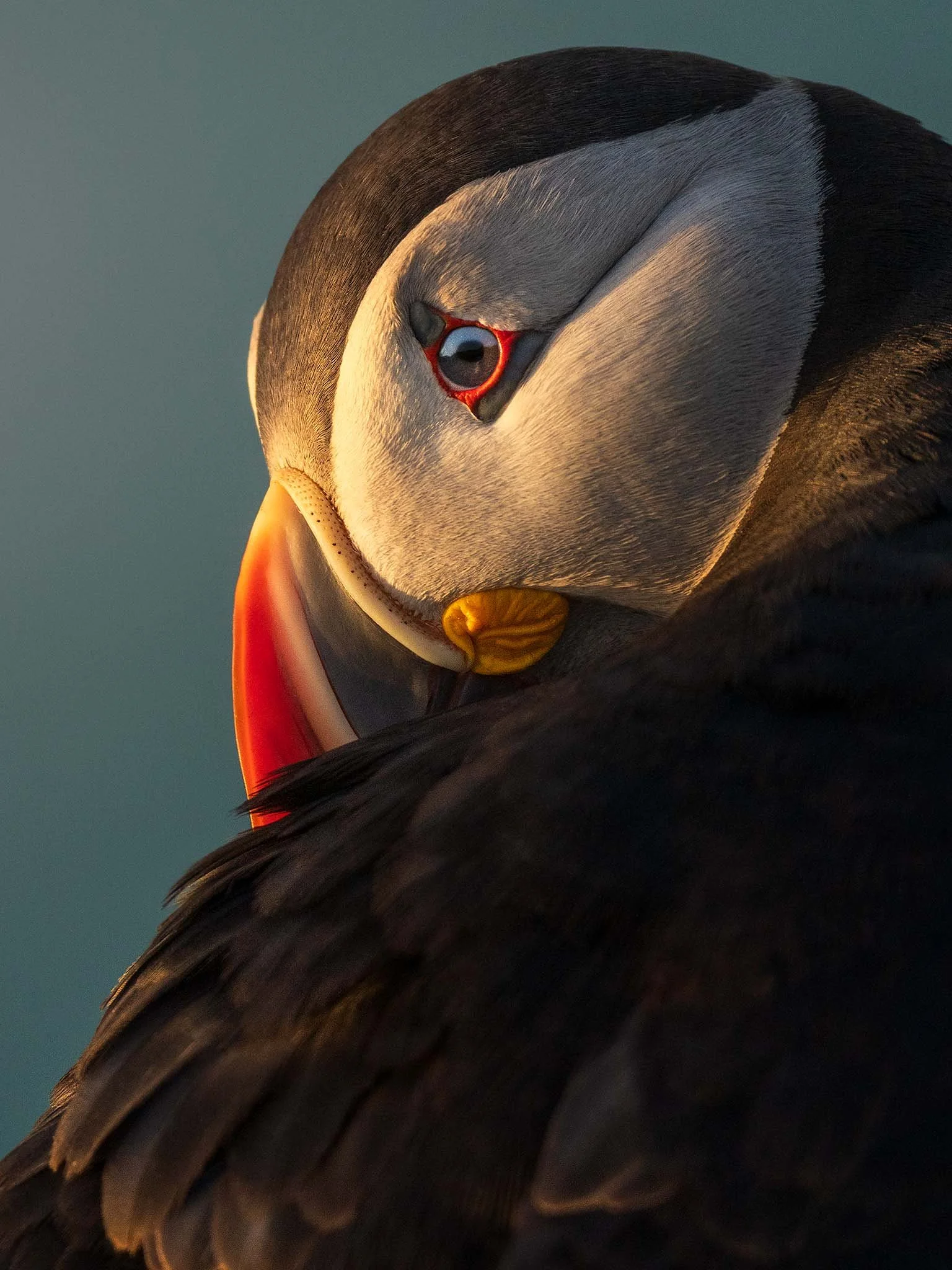
The light was the other half of it. From roughly 7PM to 9PM in the evening it did the best thing Ireland summers have going for it. Long, gold, soft light, and the whole colony lit up. The one catch is that a camera pointed at a black-and-white bird in strong light wants to average everything into grey mush, so you expose for the highlights and let the shadows go dark. Underexpose, protect the bright edges, and lift the rest in post later. The portrait I came away happiest with, the one that got a good deal of attention when I posted it, came out of exactly that. Late summer evenings here are absurdly generous, and the notorious Irish weather, for once, cooperated completely.
481mm · f/8 · 1/2000s · ISO 800
415mm · f/8 · 1/1000s · ISO 800
404mm · f/7.1 · 1/1250s · ISO 800
Planning your own Saltee puffin trip
A few practical notes if you want to go yourself. Puffins are on the Saltees from May through to about the beginning of August, so plan for roughly May into late July and do not turn up in August expecting a full house. The standard public crossing is the Saltee Ferry out of Kilmore Quay, which is the easy way to see the island on a normal day-trip window. For the later evening light I went private with Isabel and would do it again without hesitation. There are other spots around Ireland to photograph puffins, but I am partial to the Saltees. Whichever way you get out there, keep your distance from the burrows and let the birds be birds. This is their home and we are guests in it, and the photographs are better for the respect anyway.
559mm · f/6.3 · 1/800s · ISO 800